


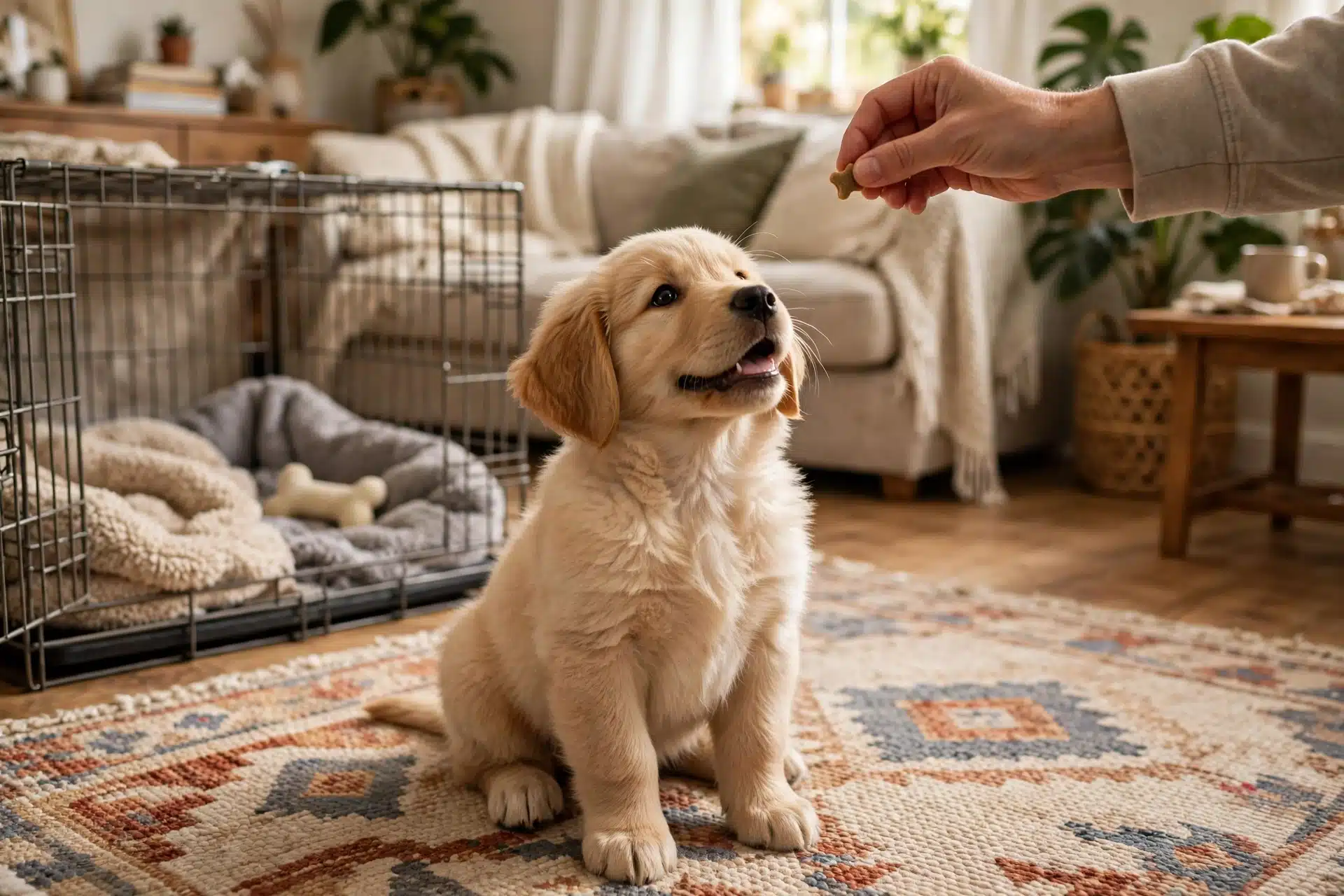
How to Train a Puppy at Home: A Gentle Start
Bringing a puppy home is one of those happy, slightly chaotic moments that stays with you. One minute the little one is asleep in your lap, and the next there is a puddle by the door, a chewed shoe, and a pair of hopeful eyes looking up at you. If that sounds familiar, you are not doing anything wrong. Every new puppy owner goes through it, and the good news is that you do not need to be a professional trainer to get it right. This guide explains how to train a puppy at home in small, calm steps that fit into a normal day, using patience and rewards instead of shouting or punishment. For more ideas on raising a happy pet, our pet care guides cover feeding, grooming and health too.
A puppy is not a small adult dog. It is a baby animal learning everything for the first time: where to sleep, where to go to the toilet, what your words mean, and which things are safe to chew. The first few months matter more than most owners realise, because habits form fast at this age. A puppy that learns where to toilet, how to settle in a crate, and how to greet people calmly will grow into a much easier adult dog. None of that needs fancy equipment or long lessons. It needs a routine, a few treats, and the same response from you every single time.
How to Train a Puppy at Home Quick Facts
Best age to start: 8 weeks old, from the first day at home
Time to become reliable: Most puppies need 4 to 6 months for house training, and some take up to a year
Session length: 5 to 10 minutes, 2 to 5 times a day
Key supplies: Crate or playpen, puppy food, small training treats, lead, collar, enzymatic cleaner, chew toys
Main method: Positive reinforcement — reward the behaviour you want, ignore or prevent the rest
Biggest rule: Never punish accidents; it teaches a puppy to hide, not to learn
Before You Start: What a Puppy Needs to Learn
It helps to see training as a short list of jobs rather than one huge task. A puppy needs to learn where to go to the toilet, how to be alone for short spells without panicking, a few words that keep it safe, and how to meet people and other animals without fear. Everything else — tricks, fancy walks, clever games — can wait.
Start with the things that make daily life work. A puppy that toilets outside, sleeps in its crate, and comes when called is already a pleasure to live with. The rest builds on that foundation, one small step at a time. Everything in this guide on how to train a puppy at home comes back to those four jobs, done a little bit every day.
You also need to get your home ready. Pick one small room or a gated corner as the puppy’s base, with a bed, water bowl, toys and a crate. Puppies do best in a small space at first, because a whole house is too much freedom too soon. Move shoes, cables, cleaning products and anything chewable out of reach. A baby gate is worth its weight in gold during the first weeks.
House Training: The First and Most Important Job
House training is where most new owners feel the pressure, and it is also where a simple routine does the most good. A puppy’s bladder is small, and it fills fast. The old rule of thumb that trainers use is that a puppy can hold it for about one hour for every month of age, plus one hour — so an eight-week-old puppy needs a toilet break roughly every two hours, and often more. That is not a failure of the puppy. It is just how young bodies work.
Take Your Puppy Out Often
Take your puppy outside first thing in the morning, after every meal, after drinking water, after a nap, after a play session, and last thing at night. Young puppies often need to go out every one to two hours while they are awake. Go to the same spot each time, because the smell helps the puppy understand what the spot is for. Stand still, stay quiet, and give the puppy a minute or two. When it goes, praise it warmly and give a small treat within a couple of seconds, right there outside. Timing matters here: a treat given back inside the house, minutes later, does not teach the puppy anything about the toilet spot.
Supervise, and Limit Freedom
When your puppy is loose in the house, keep an eye on it. Most accidents happen because the puppy was unsupervised for a few minutes and wandered off to a quiet corner. If you cannot watch, put the puppy in its crate or playpen for a short rest. Watch for the signs that a puppy needs to go: sniffing the floor, circling, squatting, or heading for the door. When you see one, pick the puppy up calmly and carry it outside straight away.
When Accidents Happen
They will happen, and that is normal. Stay calm, clean the spot with an enzymatic cleaner, and move on. Regular household cleaners often leave behind a smell that humans cannot notice but a puppy can, and that smell invites the puppy back to the same spot. Never shout at a puppy for an accident, and never rub its nose in it. Punishment after the event does not teach a puppy where to go. It teaches the puppy to be afraid of you, and to hide next time.
Crate Training, Step by Step
A crate gets a bad name sometimes, but used properly it is one of the kindest tools a puppy owner has. Dogs naturally avoid soiling the place where they sleep, so a crate that is the right size helps house training along. It also gives the puppy a safe den of its own, a place to rest when the house gets busy.
Introduce the Crate Slowly
Set the crate in a room where the family spends time, with the door open. Put soft bedding inside, scatter a few treats near the entrance, and let the puppy wander in and out on its own. Feed meals just inside the door, moving the bowl deeper over a few days. Once the puppy eats happily at the back, close the door for a few seconds while it eats, then open it again before the meal ends. Build up slowly: a few seconds becomes a minute, a minute becomes five, and soon the puppy will settle with a chew toy while you sit nearby.
Never use the crate as a punishment, and never force a puppy inside. A puppy that is pushed into a crate learns to fear it. A puppy that chooses to walk in for a treat learns to love it. Keep the crate cosy but not too big — a crate that is much larger than the puppy gives it room to use one corner as a toilet. Many crates come with a divider so the space can grow with the puppy.
How Long Is Too Long?
A puppy should not be left in a crate longer than it can comfortably hold its bladder. As a rough guide, a two-month-old puppy manages about two to three hours, and a four-month-old about five. Puppies under six months should not be crated for more than three to four hours during the day without a break for exercise and a toilet trip. Always take the puppy straight outside the moment you open the crate door.
Teaching the First Commands
Once the toilet routine is taking shape, you can start on a few words. Keep sessions short — five minutes, two or three times a day, before meals when the puppy is hungry and keen. One command at a time, in a quiet room, with a handful of small treats.
Sit
Hold a treat just above the puppy’s nose and move it slowly back over its head. As the nose follows the treat up, the bottom usually goes down. The moment it touches the floor, say “sit” and give the treat. Repeat a few times, then stop while the puppy is still enjoying it. Short sessions that end well beat long ones that end in boredom.
Come
Crouch down a few steps away, open your arms, and say the puppy’s name followed by “come” in a happy voice. When the puppy trots over, praise it and give a treat. Never call a puppy to you and then scold it, or it will learn that coming to you is a bad idea. Practise in the garden before trying it anywhere with distractions.
Down and Leave It
For “down”, lure the puppy from a sitting position with a treat moved slowly down to the floor between its paws. For “leave it”, hold a treat in a closed hand; when the puppy stops sniffing and pulls back, mark the moment with a word like “yes” and give a different treat from your other hand. These two words are the ones that will save your shoes, your dinner, and one day maybe your puppy’s safety.
Leash Training Without the Pulling
A puppy that has never worn a collar needs time to get used to it. Let the puppy wear a light collar around the house for short spells, with treats and play to make it a good thing. Then clip on a lead indoors and let the puppy drag it around for a few minutes while you watch. Once that feels normal, pick up the lead and walk around the room together.
Outside, keep it simple. Walk in a quiet street or garden, and reward the puppy for staying near you. When the puppy pulls ahead, stop walking. Wait for the lead to slacken, then move again. It feels slow at first, and it is slow. But a puppy that learns pulling gets it nowhere will walk nicely for the rest of its life, while a puppy that is dragged along on a tight lead learns the opposite.
Socialisation: Meeting the World Before 16 Weeks
The weeks between eight and sixteen are the window when a puppy learns what is normal and what is frightening. A puppy that meets different people, hears traffic, sees bicycles, and plays gently with friendly dogs during this window usually grows into a confident adult. A puppy kept indoors until its vaccinations are finished and then suddenly taken everywhere can find the world overwhelming.
That does not mean taking risks with health. Ask your vet about safe ways to socialise before the vaccination course is complete — carried outings, visits to friends’ gardens, and meeting healthy, vaccinated dogs are often fine. The aim is lots of short, positive experiences: a few minutes at a time, with the puppy free to watch from a safe distance and treats for calm behaviour. One bad fright can undo ten good meetings, so never force a puppy towards something it is scared of. Let it approach in its own time.
Biting, Chewing and Jumping Up
Puppy biting is not aggression. Puppies explore the world with their mouths, and they play-bite their littermates the same way. When your puppy bites your hand, say “ouch” in a calm voice, stop playing for a few seconds, and offer a chew toy instead. When the puppy takes the toy, praise it. The lesson is simple: hands are boring, toys are fun.
Chewing is the same story. A puppy chews because it is teething and because chewing feels good. Give it safe things to chew — rubber toys, a stuffed food toy, a frozen carrot — and keep your shoes behind a closed door. If you catch the puppy chewing something it should not, swap it for a toy without a fuss.
Jumping up is best handled by ignoring it. Turn away, wait for four paws on the floor, then greet the puppy warmly. A puppy that gets attention for jumping will jump more. A puppy that only gets attention when it is calm learns to be calm.
A Simple Daily Routine That Works
Puppies thrive on routine because it tells them what happens next. A rough day for a ten-week-old puppy might look like this: out to toilet first thing, breakfast, then out again, a short play and training session, a nap in the crate, lunch, toilet, play, another nap, dinner, toilet, a gentle evening walk or garden game, last toilet trip, and bed. Puppies sleep a lot — often 18 to 20 hours a day — and that sleep is when their brains are doing the learning. Never wake a sleeping puppy for training.
Common Mistakes New Owners Make
The most common mistake is expecting too much too soon. A puppy is not being stubborn when it forgets a command it knew yesterday. It is a baby, and its brain is still wiring itself up. Repeating a word louder does not help. Going back a step and rewarding the easy version does.
Another mistake is training in long sessions. A puppy’s attention lasts minutes, not half an hour. Three five-minute sessions a day will teach more than one long session, and they keep training fun instead of tiring.
A third mistake is changing the rules. If the puppy is not allowed on the sofa, everyone in the house has to agree. A puppy that is allowed up on Monday and scolded for it on Tuesday has no idea what the rule is. Pick the house rules early, write them down if it helps, and keep them the same.
And finally, do not compare your puppy with someone else’s. Some puppies house-train in a month, others take six. Some learn “sit” in a day, others need a week. The puppy in front of you is the only one that matters.
Common Confusions
Because puppy advice is everywhere online, a few ideas keep getting repeated that deserve a closer look.
“A puppy should be fully trained by six months.” Most puppies need four to six months to become reliable with house training, and some need up to a year. That is normal, and it is not a sign that you or the puppy have failed.
“Rubbing a puppy’s nose in a mess teaches it.” It does not. It teaches the puppy to fear you and to hide its messes. Cleaning up calmly and improving the routine is the only thing that works.
“Crate training is cruel.” A crate used properly — the right size, introduced slowly, never as punishment, and never for too long — is a den, not a cell. Many puppies choose to nap in their crate with the door open once they are used to it.
“You must wait until all vaccinations are done before socialising.” Total isolation until the vaccination course ends can leave a puppy fearful of the world. Vets generally advise safe, controlled introductions during the early weeks, such as carried outings and meeting healthy vaccinated dogs. Ask your own vet what is safe in your area.
“Old-fashioned dominance methods work faster.” Shouting, pinning a puppy down, or using fear may stop a behaviour for a moment, but it damages trust and often makes behaviour worse. Reward-based training is slower to describe and faster in real life, because the puppy wants to repeat what earns a treat.
Frequently Asked Questions
When should I start training my puppy?
From the first day at home, usually at around eight weeks old. Start with the toilet routine, the puppy’s name, and the crate. Short, gentle sessions from day one beat waiting until the puppy is older.
How long does it take to house train a puppy?
Most puppies need four to six months to become reliable, and some take up to a year. Steady routine, frequent toilet trips and instant rewards outside are what get you there. Night-time dryness usually comes last.
How many times a day should I train my puppy?
Two to five short sessions of five to ten minutes each is plenty. Puppies learn best in short bursts, and training before meals works well because the puppy is keen for its treats.
Is crate training necessary?
It is not the only way, but it helps a lot. A crate speeds up house training, keeps the puppy safe when you cannot watch it, and gives it a quiet place to rest. A small gated room can work as an alternative if a crate does not suit your home.
What should I do when my puppy bites?
Stay calm, say “ouch”, stop playing for a moment, and offer a chew toy. Praise the puppy when it takes the toy. Biting is normal puppy behaviour, and it fades as the puppy learns that hands are not toys.
When can my puppy meet other dogs?
Ask your vet, because advice depends on local disease risk and the vaccination schedule. In general, short meetings with healthy, vaccinated dogs and carried outings are a good way to start socialisation before the vaccination course is finished.
My puppy only listens at home. Why?
Because puppies do not generalise well. A puppy that sits in your kitchen has learned to sit in your kitchen, not everywhere. Practise each command in new places — the garden, the pavement, a friend’s house — a little at a time, and the skill will travel with you.
Conclusion
A new puppy asks for a lot in the first months: early mornings, muddy paws, chewed table legs, and more patience than you thought you had. What it gives back is just as real — a dog that trusts you, settles beside you, and comes when you call. The method is not complicated. Take the puppy out often, reward the right thing at the right moment, keep lessons short, and never punish a mistake. If you follow the steps in this guide on how to train a puppy at home, you will see progress week by week, even on the days when it feels like nothing is working. And if you ever feel stuck, ask your vet or a reward-based trainer for a hand. For more background on dogs and how they learn, a general reference is a good place to start.
