


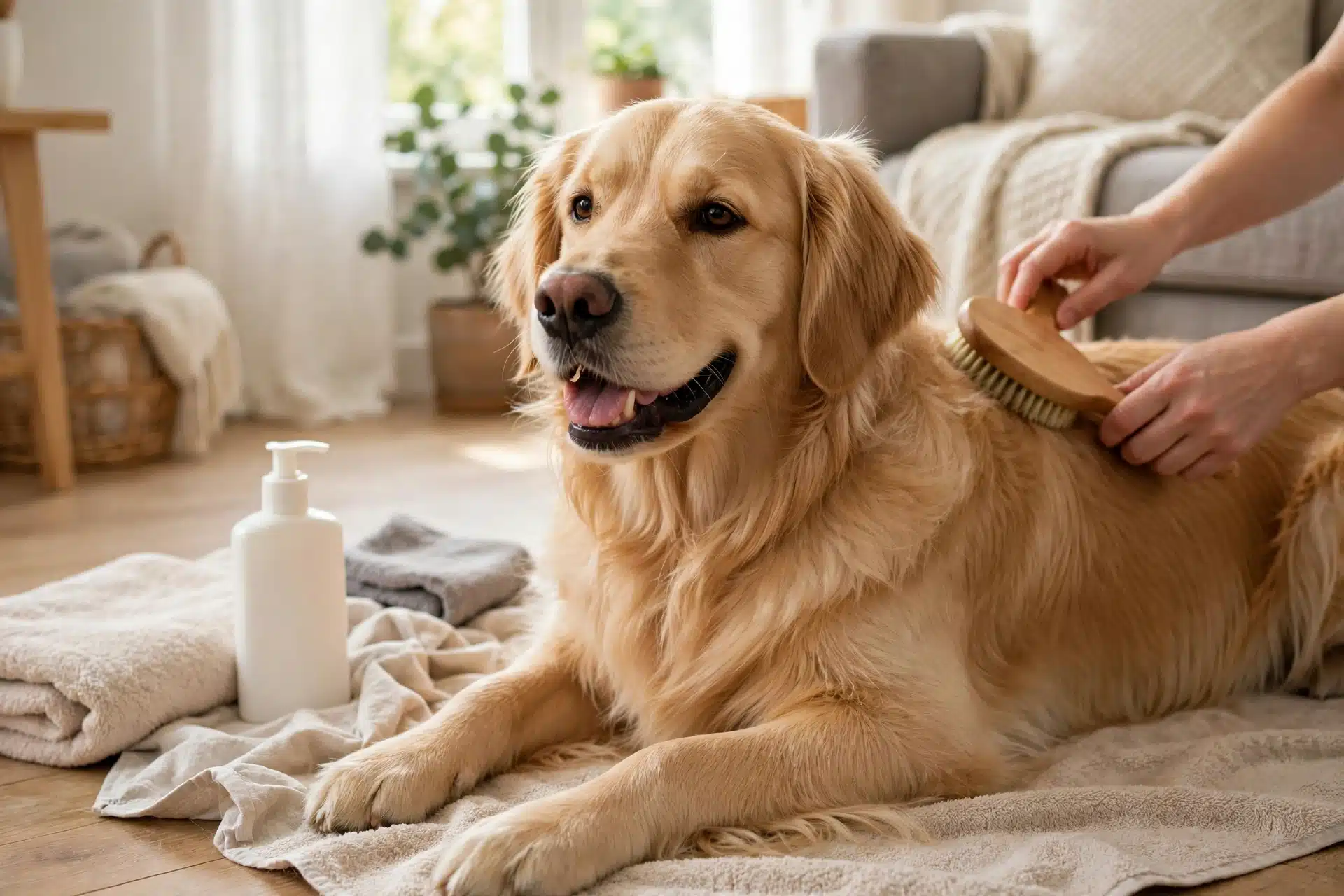
If you have ever wondered how to groom a dog at home without turning the bathroom into a swamp and the dog into a nervous wreck, the honest answer is that it is simpler than it looks — once you know the order of the jobs and which ones actually matter. Most of what grooming is comes down to six things: brushing, bathing, drying, nails, ears and teeth. None of them needs fancy equipment, and none of them needs to be done perfectly the first time. What they need is a calm dog, the right tools for the coat in front of you, and a routine you can repeat without a fight.
Grooming is not really about making a dog look smart for photographs, although that is a nice side effect. A regular brush-through is how you find a tick, a sore patch, a lump or a mat before it becomes a problem. Short nails are how a dog walks properly instead of shifting its weight to avoid the pain of overgrown claws. Clean ears are how you catch an infection while it is still a smell and a bit of redness, rather than a vet bill and a miserable dog. Plenty of pet care tips focus on food and walks, and both matter, but the hands-on check that happens during grooming is one of the best early-warning systems a dog owner has.
Quick Facts
- What home grooming covers: Brushing, bathing, drying, nail trimming, ear checks, teeth brushing and paw care
- Best order: Brush dry first, then nails, then bath, then dry, then ears, eyes, paws and teeth
- Brushing: Weekly for short coats, two to three times a week for double coats, daily for long or curly coats
- Bathing: Every four to eight weeks, or whenever the dog is dirty or smelly — not on a fixed schedule
- Nails: Every three to four weeks, or whenever you hear clicking on hard floors
- Ears: Check weekly; clean only when your vet advises it or when there is visible dirt
- Teeth: Brush several times a week with dog toothpaste; daily is ideal
- Shampoo: Dog shampoo only — human shampoo can dry out and irritate a dog’s skin
- Leave to a professional: Full haircuts, tight mats, and anything your dog strongly resists
Why Grooming Matters More Than Looks
A dog’s coat is not decoration. When a coat is full of loose dead hair and tangles, it stops doing that job properly. Mats pull at the skin, trap moisture underneath, and can hide sores that go unnoticed for weeks. Brushing is the cheapest way to stop all of that, and it spreads the natural oils through the coat, which is what gives a healthy dog that soft shine people notice.
Grooming also builds trust in a very practical way. A dog that lets you touch its paws, lift its ears and open its mouth without panicking is a dog that is far easier to look after when something goes wrong. The vet can examine it without a struggle. You can pull out a thorn, check a cut, or give medicine without a chase around the kitchen. Every calm grooming session is practice for those moments, and it pays off quietly over the years.
The Tools You Actually Need
You do not need a salon’s worth of equipment. A small kit, bought once and kept together in one box, covers almost everything. The trick is buying tools that suit your dog’s coat rather than buying every gadget on the shelf.
- A brush that matches the coat. A slicker brush suits medium and long coats and works through tangles. A bristle brush or rubber curry brush suits short, smooth coats and lifts loose hair without scraping the skin. An undercoat rake or de-shedding tool suits double-coated breeds like retrievers, huskies and shepherds.
- A metal comb. This is the tool that tells you the truth. After brushing, run a comb through the coat down to the skin. If it glides through, the coat is clear. If it stops, there is a tangle or a mat you missed.
- Dog shampoo and, if needed, conditioner. Pick a gentle dog shampoo, and a conditioner for long coats that tangle easily. Never use human shampoo: a dog’s skin has a different balance from ours, and human products can dry it out and cause itching.
- Nail clippers or a nail grinder. Guillotine or scissor-style clippers work well for most dogs; a grinder is gentler for nervous dogs and smooths the nail edge. Keep styptic powder nearby in case you nick the quick — it stops the bleeding fast.
- Ear cleaner and cotton balls or pads. Use a vet-approved ear cleaner. Cotton balls are for wiping the outer ear only. Never use cotton swabs inside the ear canal.
- A dog toothbrush and dog toothpaste. Human toothpaste contains ingredients that are harmful to dogs, so this is one swap that is not optional. A finger brush works well for dogs that hate a long-handled brush.
- Blunt-tipped scissors and thinning shears. For trimming the fur between the toes and around the paws, and tidying the hair around the eyes. Blunt tips are a safety rule, not a preference.
- Towels, lots of them. Two or three old towels at least. A non-slip mat for the bath or shower, and treats — small, soft ones you can hand out quickly without stopping the job.
Know Your Dog’s Coat First
Everything in grooming starts with the coat, because the coat decides the brush, the frequency and how much work is involved. Dogs fall into a few broad groups, and most owners can tell which one they have just by looking and feeling.
Short, Smooth Coats
Beagles, boxers, Labradors, Staffies and similar breeds have short coats that lie flat. They are the easiest to look after. A rubber grooming mitt or a soft bristle brush once a week lifts the loose hair and keeps the coat glossy. During heavy shedding seasons, brush more often — a few minutes a couple of times a week is enough.
Long Coats
Collies, Afghan hounds, Shih Tzus, Yorkshire terriers and other long-coated breeds need daily brushing. The hair tangles easily, especially behind the ears, under the legs and around the collar, and a tangle left for a few days becomes a mat. Use a slicker brush first, then follow with a metal comb to check your work down to the skin. Work in small sections and start at the ends of the hair, moving toward the skin, so you are not pulling at the roots.
Double Coats
Golden retrievers, huskies, German shepherds and many similar breeds have a soft undercoat beneath a tougher outer coat. They shed heavily, especially in spring and autumn, and that is when the work piles up. An undercoat rake used two or three times a week pulls out the dead undercoat before it packs into mats. Never shave a double-coated dog to make the shedding stop: the coat protects the dog from heat as well as cold, and shaving can damage the way it grows back.
Curly and Wavy Coats
Poodles, Bichon Frises, Cockapoos and other curly-coated dogs tangle fast and mat faster. Brush three or four times a week with a slicker brush, then comb through to the skin. Curly coats usually need professional haircuts every four to eight weeks, because the hair keeps growing and the shape gets out of hand.
The Best Order for a Full Grooming Session
The order matters more than most people expect, and the order below is the one most groomers follow when they explain how to groom a dog at home to a beginner. It exists for a reason: each step makes the next one easier.
1. Brush and comb the whole coat while it is dry. Water tightens tangles into mats, so never bath a tangled dog. Work out every knot first. 2. Trim the nails while the dog is still calm and dry. Some people prefer to do nails after the bath, when they are slightly softer, and that works too — but dry is simpler, and you can see what you are doing. 3. Check and wipe the ears and eyes, so you spot redness or a bad smell before shampoo hides it. 4. Bathe and rinse, starting from the neck and working back, and doing the face last with a damp cloth. 5. Dry thoroughly, then give the coat one last comb to catch the tangles that formed while towel drying. 6. Finish with paws and teeth, applying paw balm to clean, dry pads and brushing the teeth as the last job.
Step 1: Brushing the Coat
Brushing is where every session starts, and it is the job you will do most often, so it is worth doing properly. Pick a quiet spot where the dog can stand or lie comfortably, and where you are not going to be interrupted. Put a treat in your pocket. Start at the neck and work toward the tail, brushing in the direction the hair grows, in small sections. For long coats, use the line-brushing method: part the coat down to the skin, brush one small section at a time from the skin outward, then move on to the next part. It is slower than sweeping the brush over the top, but it is the only way to reach the tangles hiding underneath.
When you hit a tangle, stop. Hold the base of the tangle with your fingers so you are not pulling the skin, and work it apart gently with the comb, starting at the outer edge. If a mat is tight, packed close to the skin and painful to touch, do not force it — that is a job for a groomer, who can remove it safely. Cutting a mat out with scissors is risky, because the skin is often pulled up inside the mat and you cannot see where the skin ends and the hair begins.
Step 2: Trimming the Nails
Nail trimming is the job most owners dread, and the one most dogs dislike, but it matters. Overgrown nails change the way a dog stands and walks, and they can split, snag and cause real pain. If you can hear clicking when the dog walks across a hard floor, the nails are too long.
Start by getting the dog used to having its paws handled on ordinary days, when no clippers are involved. Touch the paws, press the pads gently, hold each toe for a second, then give a treat. A few days of that makes the real thing much easier. When you are ready to trim, work in good light and take your time. Hold the paw firmly but gently, and clip only the tip of the nail — a millimetre or two at a time. Inside every nail is the quick, the pink core that carries blood vessels and nerves. On light nails you can see it. On dark nails you cannot, so take thin slices and stop when you see a darker dot appear in the centre of the cut surface.
Cut at a slight angle, following the natural curve of the nail, and keep the styptic powder within reach. If you do nick the quick, press the powder onto the tip and hold it there for a moment. It stings, the dog will object, and it is not a disaster — it happens to professionals too. Take a break, give a treat, and finish the rest another day if the dog has had enough. A grinder is a good alternative for nervous dogs: it files the nail down gradually and is much less likely to cut the quick, although it takes longer and makes a noise some dogs dislike.
Step 3: Bathing Your Dog
Most dogs only need a bath when they are dirty or smelly. The usual range is every four to eight weeks, but a dog that swims in muddy water or rolls in something unpleasant needs one sooner, and a clean indoor dog can go longer. Overbathing dries out the skin, so a bath on a fixed schedule, whether the dog needs it or not, is not the goal.
Before the water goes anywhere near the dog, brush the coat out. This is the rule people forget, and it is the one that causes the most trouble: water tightens tangles into mats, and a matted coat that gets wet is much harder to sort out afterwards. Put a non-slip mat in the tub or shower, and use lukewarm water — never hot. Wet the coat thoroughly, starting at the neck and working back toward the tail, and keep the water out of the ears and eyes.
Apply the dog shampoo and work it into a lather, massaging it through the coat down to the skin. Wash the body first and the face last, using a damp cloth for the face rather than pouring water over it. Rinse until the water runs completely clear — shampoo left in the coat irritates the skin and makes the fur look dull.
Step 4: Drying the Coat
Drying is not an afterthought. A dog left damp in a cold house can chill, and a damp coat mats faster than a dry one. Start with towels and squeeze the water out of the coat rather than rubbing hard, which tangles the hair. Press the towel against the body, work down the legs, and dry the ears and paws properly — skin folds and the spaces between the toes stay damp longest and are where irritation starts.
A hair dryer on a low, cool setting is fine if the dog accepts it, but keep it at a distance and keep it moving. Never aim hot air at one spot, and never use it on thin skin like the belly or the inside of the legs. Many dogs hate dryers, and for them towels plus a warm room are enough.
Step 5: Ears and Eyes
Ears deserve a weekly look, not a weekly scrub. Lift the ear flap and look inside: a healthy ear is clean, pale pink, and smells of nothing much. A little wax is normal. Redness, a strong smell, dark discharge or a dog that keeps shaking its head or scratching at its ear are all signs to call the vet before you clean anything.
If the ears are dirty but otherwise healthy, wipe the visible part with a cotton pad and a vet-approved ear cleaner. Massage the base of the ear gently for a few seconds, let the dog shake its head, then wipe away what comes out. Never push anything into the ear canal — no cotton swabs, no fingers, no homemade mixtures. Alcohol and hydrogen peroxide irritate the sensitive tissue inside the ear and should stay in the cupboard. Healthy ears, by the way, do not need routine cleaning at all: many vets advise leaving them alone unless there is a reason to clean them.
Step 6: Brushing the Teeth
Teeth are the grooming job most owners skip, and the one that causes the most trouble later. Plaque builds up fast, gum disease is common in dogs, and a sore mouth changes how a dog eats and behaves. Brushing several times a week makes a real difference, and daily is ideal if you can manage it.
Use a dog toothbrush or a finger brush, and toothpaste made for dogs — never human toothpaste, which contains ingredients that are harmful when swallowed, and dogs always swallow it. Let the dog lick a little toothpaste from your finger first, so the taste is not a surprise. Then lift the lip gently and brush in small circles along the gum line, focusing on the outer surfaces of the teeth, which is where plaque collects. Keep it short at first — thirty seconds is a win for a beginner — and build up gradually.
Step 7: Paws and Finishing Touches
Paws take a beating. They walk on hot pavements in summer, cold ground and salt in winter, and rough paths all year. After a bath, check each paw: look between the toes for stones, thorns or matted hair, check the pads for cracks or cuts, and feel for anything tender. A paw balm rubbed into clean, dry pads helps keep them supple, especially in winter. In hot weather, check the pavement with the back of your hand — if it is too hot for you to hold your hand there for a few seconds, it is too hot for bare paws.
How Often Should You Groom Your Dog?
There is no single schedule that fits every dog — adjust the guide below to the dog in front of you.
- Brushing: Short coats once a week; medium and double coats two to three times a week; long and curly coats daily.
- Bathing: Every four to eight weeks, or whenever the dog is dirty or smelly.
- Nails: Every three to four weeks, or when you hear clicking on hard floors.
- Ears: Check weekly; clean only when there is visible dirt or your vet advises it.
- Teeth: Several times a week at least; daily is ideal.
- Paws: Check after walks on rough ground, and trim the fur between the toes every few weeks.
Keeping a Nervous Dog Calm
Some dogs love grooming. Most tolerate it. A few hate it, and for those dogs the routine matters more than the tools. Keep sessions short — five or ten minutes is enough at first — and always end on a good note, with a treat and a bit of play. Never chase a dog that has walked away; let it come back to you, or try again tomorrow. A half-groomed calm dog is worth more than a finished groom that ends in a struggle.
Work in a quiet room without other pets underfoot, and keep your own voice low and steady. Dogs read your tension faster than you think. If you are nervous about the nail clippers, the dog will be too, so practise holding the clippers and touching the paws on days when you are not going to cut anything.
Common Mistakes to Avoid
- Bathing before brushing. Water tightens tangles into mats. Always brush first, bath second.
- Using human shampoo. A dog’s skin has a different balance from human skin, and human shampoo dries it out and causes itching.
- Using human toothpaste. It contains ingredients that are harmful to dogs. Dog toothpaste only.
- Cutting too much nail at once. Take a millimetre or two at a time, and keep styptic powder nearby.
- Pushing things into the ear canal. Cotton swabs, fingers and home mixtures do not belong in there. Wipe the outer ear only.
- Bathing too often. Overbathing strips the natural oils and dries the skin. Bath when the dog is dirty or smelly, not on a schedule.
- Cutting out mats with scissors. The skin is often pulled up inside a mat. Leave tight mats to a groomer.
- Shaving a double-coated dog. The coat protects against heat as well as cold, and shaving can damage how it grows back.
- Doing everything in one long session. Short, calm sessions beat one long battle, every time.
Common Confusions
Do all dogs need regular baths? No. Bathing frequency depends on the coat, the lifestyle and the season. A short-coated dog that lives indoors may need a bath only every couple of months, while a long-coated dog that loves muddy puddles needs one far more often. The test is simple: if the dog smells or is visibly dirty, it is bath time. A fixed schedule that ignores the dog in front of you is not good care.
Is it safe to cut a dog’s hair at home? Tidying the fur between the toes and around the eyes with blunt-tipped scissors is fine. A full haircut with clippers is a different job, and it is easy to cut the skin, especially around the ears, the belly, the groin and the armpits, where the skin is thin and loose. Unless you have been shown how to do it safely, leave haircuts to a professional groomer.
Do short-haired dogs need grooming at all? Yes, just less of it. Short coats still shed, still get dirty, and still need nails, ears and teeth looked after. A weekly brush, a bath when needed and regular nail trims are enough for most short-coated breeds, and skipping those basics causes the same problems as skipping them on a long-coated dog.
Frequently Asked Questions
How often should I brush my dog?
It depends on the coat. Short, smooth coats need a brush about once a week. Medium and double coats need two to three sessions a week, especially in shedding season. Long and curly coats need daily brushing to stop tangles turning into mats.
Is it safe to learn how to groom a dog at home?
Yes, if you go gently and stick to the basic jobs — brushing, bathing, nails, ears and teeth. Leave haircuts, tight mats and anything your dog strongly resists to a professional groomer.
How do I trim my dog’s nails without hurting them?
Clip only the tip, a millimetre or two at a time, and stop before you reach the quick — the pink core inside the nail. On dark nails, take thin slices and stop when a darker dot appears in the centre of the cut. Keep styptic powder nearby in case of a nick, and if the dog is very nervous, a nail grinder is a gentler option that files the nail down gradually.
How often should I bathe my dog?
Most dogs need a bath every four to eight weeks, or whenever they are dirty or smelly. Always brush the coat out before the bath, use lukewarm water and a dog shampoo, and rinse until the water runs completely clear.
Can I clean my dog’s ears at home?
You can wipe the outer ear with a cotton pad and a vet-approved ear cleaner, and that is enough for most dogs. Never push anything into the ear canal. If the ears are red, smelly, full of dark discharge, or the dog keeps shaking its head, see the vet before cleaning anything — those are signs of an infection, not dirt.
What should I do if my dog hates being groomed?
Keep sessions short, end on a good note with a treat, and split the jobs across several days instead of doing everything at once. Practise touching the paws, ears and mouth on ordinary days when no grooming is happening. If the dog growls, snaps or panics, stop and try again another day.
Conclusion
Grooming a dog at home is not a skill you are born with; it is a habit you build, one short session at a time. The routine is simple once you know it: brush the dry coat first, trim the nails, bath with a dog shampoo, dry properly, check the ears and eyes, brush the teeth, and look after the paws. Do the brushing often, the bathing when it is needed, and the rest on a steady rhythm that fits your dog’s coat and life. Learning how to groom a dog at home takes a few messy sessions before it feels natural, and that is normal — the dog is learning too.
The payoff is a dog that looks well, feels comfortable, and trusts your hands — and you will spot problems early, before they become expensive ones. For readers who want to check the background of the animals and the care ideas in this guide, a general reference is a good place to start.
