


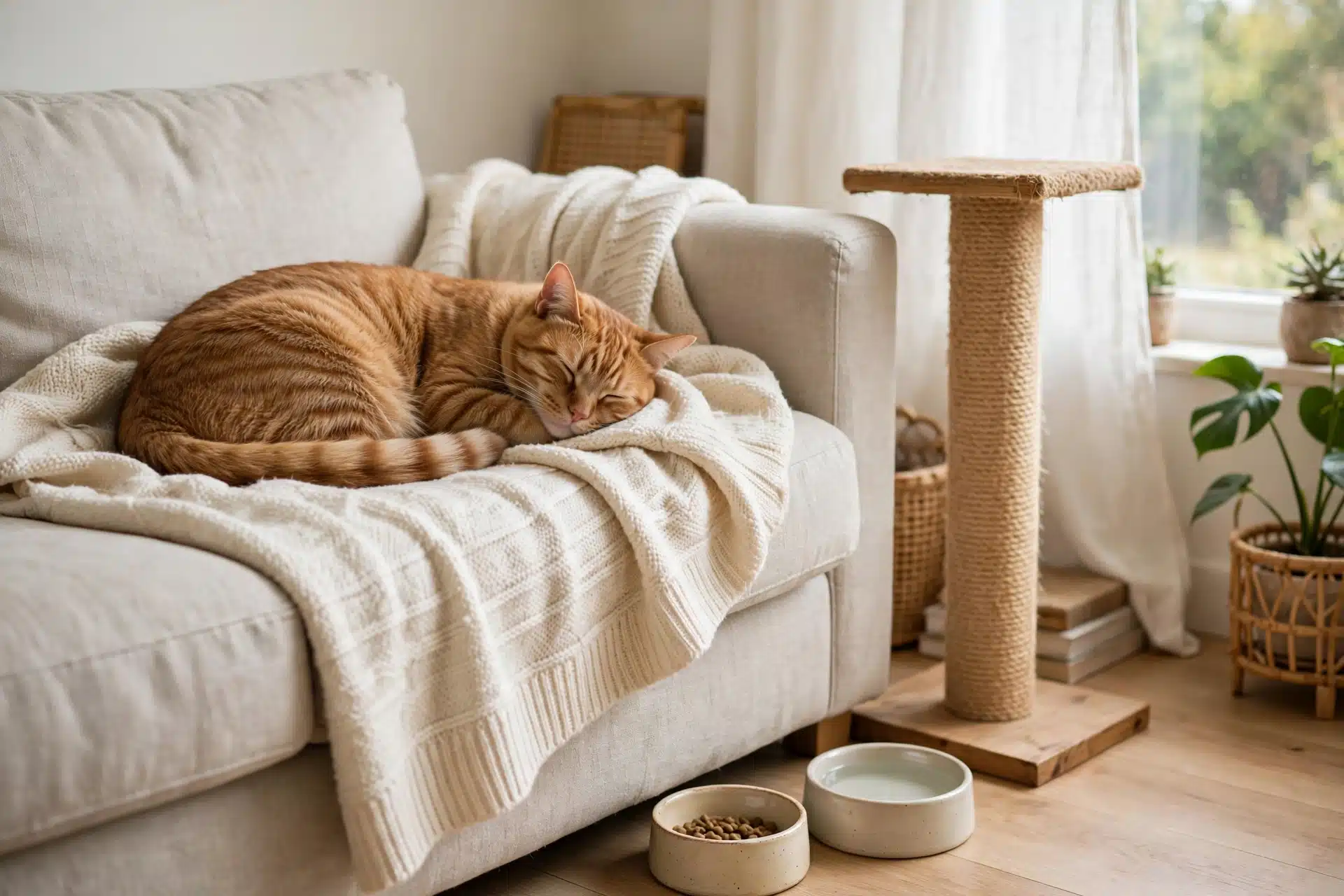
A cat does not ask for much. A full bowl, a clean place to do its business, a warm spot to sleep, and someone who notices when something changes. That is the whole job, really — and the difference between a cat that merely survives in your house and one that settles in and purrs on your lap is usually routine. Cats love routine: knowing where the food is, where the litter tray sits, and that the same quiet person will be around at the same times each day.
Learning how to take care of a cat at home is mostly about paying attention. You do not need expensive gadgets — you need a steady daily rhythm, a bit of patience in the first weeks, and the habit of noticing when your cat eats less, hides more, or stops doing the things it usually enjoys. This guide walks through all of it: food and water, litter, grooming, play, vet care, kittens, older cats, and the signs that mean it is time to call the vet. If you are new to pet care tips, start here and take it one section at a time.
Quick Facts
- First vet visit: Within the first week or two after bringing your cat home
- Feeding: A complete and balanced food matched to life stage — kitten, adult or senior
- Water: Fresh water available at all times, in a clean bowl
- Litter boxes: One per cat, plus one extra
- Litter care: Scoop waste at least once a day
- Grooming: Short-haired cats need a weekly brush; long-haired cats usually need daily brushing
- Play: Short play sessions every day, with toys that let your cat stalk and pounce
- Vet checkups: At least once a year for healthy adults; twice a year for seniors
- Core vaccines: FVRCP and rabies, with the exact schedule set by your vet
- Indoor or outdoor: Indoor cats face fewer dangers, but they need more play and climbing space at home
- Spaying and neutering: Usually around five to six months of age — ask your vet about timing
Before Your Cat Comes Home
The best time to get ready is before the cat arrives, not after. A new cat, especially one coming from a shelter or a breeder, walks into a strange house full of strange smells and strange sounds. Everything is unfamiliar, and a cat that feels cornered will hide — sometimes for days. That is normal. Your job in the first week is to make the house feel smaller and safer, not bigger.
Start with one quiet room. Put the food bowl, water bowl, litter box, bed and a hiding place in it, and let the cat settle there first. A cardboard box with a hole cut in the side works just as well as a shop-bought cat bed. Visit often but quietly, and let the cat come to you.
Ask the person or shelter the cat came from what food it was eating and what litter it was used to. Keep both the same for the first couple of weeks, even if you plan to switch later — a sudden change of food on top of a new home is a fast way to an upset stomach.
Feeding Your Cat Well
Food is the foundation of cat care. Cats are obligate carnivores, which means their bodies are built to get key nutrients from animal protein — taurine, for example, is an amino acid cats need for healthy eyes and heart, and it comes from animal tissue. Look for food labelled complete and balanced for your cat’s life stage: kitten food for growth, adult food for maintenance, senior food for easier digestion.
Look for food labelled complete and balanced for your cat’s life stage. Kitten food is made for growth, with more calories and nutrients per bite. Adult food is made for maintenance. Senior food is usually lighter and easier to digest, though the right choice depends on the individual cat and your vet’s advice. The label matters more than the price or the brand name on the front of the bag.
How much to feed depends on age, weight, activity and whether the cat lives indoors. Kittens under six months usually need three or four small meals a day, and most adult cats do well on two measured meals. Free-feeding — leaving a full bowl out all day — is one of the easiest ways for an indoor cat to put on weight, so measure the food and adjust with your vet if the cat is gaining or losing.
A few foods that seem harmless are best kept away from cats altogether. Most adult cats cannot digest cow’s milk properly, and it often causes an upset stomach. Raw meat and unpasteurised milk can carry germs, and onions, garlic, grapes, chocolate and lilies are dangerous for cats — lilies in particular can cause serious kidney damage, even in small amounts, so they do not belong in a house with a cat.
Fresh Water, Every Day
Water sounds too simple to mention, and that is exactly why it gets forgotten. A cat should always have clean, fresh water available, even if it eats wet food. Many cats are fussy drinkers — some will not drink from a bowl placed next to their food — so try putting the water bowl in a different spot and see if your cat drinks more.
Some cats drink far more from a pet water fountain, or from a wide, shallow bowl that does not touch their whiskers. There is no single right answer — watch what your cat actually does and set things up to suit it.
The Litter Box: Getting It Right
Litter box problems are one of the most common reasons cats are given up, and most of them are easy to prevent. The rules are simple, and they work.
The standard advice is one box per cat, plus one extra, in different, quiet spots — not all lined up in a row in one corner. A cat needs to feel it has a choice, and a nervous cat will not walk past another cat to reach the only tray in the house.
Pick a box about one and a half times your cat’s length, from nose to the base of the tail, so the cat can turn around comfortably. Kittens and older cats with stiff joints need a low entry side, and most cats prefer soft, unscented litter — strongly scented litter smells overwhelming to a cat, whose sense of smell is far sharper than ours.
Scoop the waste at least once a day — twice is better — and wash the box with soap and hot water regularly before refilling. A dirty box is the fastest way to teach a cat to go elsewhere. Keep the box away from the food and water bowls, in a quiet spot the cat can reach at any hour, not next to a noisy washing machine.
One more thing worth knowing: a change in litter habits is information. If a cat that always used the tray suddenly starts going elsewhere, or strains, cries, or visits the tray far more often than usual, do not assume it is being naughty. Straining to pass urine, in particular, can be an emergency, especially in male cats. Call the vet the same day.
A Home That Feels Safe
A cat’s home is not one room — it is a map of places. Cats organise their lives around separate areas for eating, drinking, sleeping, playing and doing their business, and they are happiest when those areas are kept apart. A food bowl next to a litter tray is not just untidy, it is stressful for the animal.
Height matters to cats in a way it does not to us. A cat that can climb onto a shelf, a wardrobe or a cat tree feels safer than one stuck at floor level, and a window perch gives an indoor cat a lookout and a retreat in one — the world outside becomes television.
Hiding places matter just as much. A covered bed, a box, or a cupboard left ajar gives a nervous cat somewhere to disappear to, and a cat that knows it can hide is usually a calmer cat. Let the cat choose when to come out — dragging a hiding cat into the open undoes trust in seconds.
Play, Scratching and Rest
Cats sleep a lot — often most of the day — and that is normal. But the hours they are awake need activity: play is how a hunter practises hunting, and a bored cat will find its own entertainment, usually in your curtains, your ankles, or the furniture.
Short play sessions work best: ten or fifteen minutes, once or twice a day, with a wand toy or a small ball. Let the cat catch the toy sometimes — a game that never ends in a catch is frustrating, not fun. Rotate toys so they stay interesting, and put string toys away after playtime.
Scratching is another behaviour owners often try to stop, when they should be redirecting it. Cats scratch to stretch, to mark their territory, and to keep their claws in shape. A sturdy scratching post — tall enough for a full stretch, heavy enough not to topple — placed near the cat’s favourite sleeping spot will save your sofa. Punishing a cat for scratching does not work; it just makes the cat nervous.
Grooming: Coat, Claws, Ears and Teeth
Most healthy short-haired cats look after their own coats remarkably well. A weekly brush is still worth doing, because it removes dead hair that would otherwise be swallowed during grooming and come back as hairballs. Long-haired cats usually need daily brushing or combing, and the spots behind the ears, under the front legs and around the back legs are where tangles start. Keep sessions short and calm — a few minutes, a gentle brush, and a treat at the end.
Keep grooming sessions short and calm. A few minutes, a gentle brush, and a treat at the end will do more than a long wrestling match ever will. If you find a tight mat, do not reach for scissors — skin can hide inside a mat and be cut easily, so let a groomer or your vet deal with it.
Check the claws now and then, including the small dewclaws on the inner side of the front paws, which do not wear down the same way. You can trim just the sharp tip once your vet or a groomer has shown you how — the pink part inside the claw, the quick, has nerves and blood vessels, so trim well away from it. If you are nervous, leave it to the professionals.
Ears and teeth are easy to overlook. A quick look at the ears now and then is enough — discharge, a bad smell, or repeated head shaking means a vet visit. Dental disease is one of the most common health problems in cats, and it is painful, so ask your vet to check the teeth at each visit and to show you how to brush them with a cat toothbrush and cat toothpaste.
Vet Visits, Vaccines and Preventive Care
A cat that looks fine still needs a vet. Cats are very good at hiding illness — it is an instinct, not a trick — so by the time a cat looks obviously unwell, the problem may have been there for a while. Regular checkups catch things early, when they are easier and cheaper to deal with.
Book the first checkup within a week or two of bringing your cat home. Bring any records you have from the shelter or breeder. The vet will examine the cat, talk about vaccines, parasite prevention and microchipping, and answer your questions. Healthy adult cats should be seen at least once a year. Senior cats — roughly from the age of ten onwards — do better with a checkup every six months.
The core vaccines most vets recommend are FVRCP, which protects against feline viral rhinotracheitis, calicivirus and panleukopenia, and rabies, which is required by law in many places. Kittens usually start FVRCP at around six to eight weeks old, with boosters every three to four weeks until about sixteen weeks. Your vet will set the exact schedule, and it is worth keeping a note of the dates.
Parasites need a plan too. Even indoor cats can pick up fleas and worms, so ask your vet about prevention for fleas, intestinal worms and, where it applies, heartworm.
Spaying and neutering is one of the most useful things you can do for a cat’s long-term health. It prevents unwanted litters, reduces certain health risks, and can cut down on roaming, spraying and yowling. Many vets recommend doing it at around five to six months, though the timing can vary, so ask your vet what suits your cat.
Indoor, Outdoor or Both?
This is one of those questions where every cat owner has an opinion, and the honest answer is that it depends on where you live and what your cat is like. Indoor cats generally live longer and face fewer dangers — no traffic, no fights with other cats, no predators, fewer parasites and fewer infectious diseases. The trade-off is boredom, so an indoor cat needs climbing space, window views, scratching posts and daily play.
The trade-off is boredom. An indoor cat with nothing to do will make its own fun, and you may not enjoy the results. If your cat lives indoors, the enrichment matters: climbing space, window views, scratching posts, hiding places and daily play. A cat tree by a window, a few toys rotated regularly, and ten minutes of play a day will keep most indoor cats content.
If your cat does go outside, wait until it is vaccinated, microchipped and neutered, and make sure it can always get back in. A secure garden enclosure or a harness and lead gives the cat fresh air and smells without the risks of roaming free.
Kittens: The First Months
A kitten is not a small adult cat. Kittens need more calories, more protein and certain nutrients for growth, brain and eye development, so they need food made for kittens — labelled complete and balanced for growth — until they are about a year old. Feed kittens three or four small meals a day, and keep the food the same as what the kitten was eating before you brought it home, at least for the first few weeks.
Feed kittens three or four small meals a day. Their stomachs are small and their energy needs are high, so little and often works better than one big meal. Keep the food the same as what the kitten was eating before you brought it home, at least for the first few weeks, then change it gradually if you need to.
Litter training is usually easy — most kittens take to a litter box on their own. Use a low-sided tray a kitten can climb into, with unscented litter, and place it somewhere quiet and easy to reach. Show the kitten where it is on the first day, and praise it gently when it uses the tray. Never punish a kitten for an accident.
Kittens need several vet visits in their first year, for vaccines, health checks, a faecal exam and deworming, and testing for feline leukaemia virus and feline immunodeficiency virus if they came from unknown circumstances. This is also the time to talk about spaying or neutering.
Senior Cats: Slowing Down Gracefully
Cats age more gracefully than most animals, but they do age. A cat of ten or eleven is roughly in its late fifties or sixties in human terms. Senior cats need the same care as younger ones, with a few adjustments — most importantly, checkups every six months, because kidney disease, thyroid problems, dental disease and arthritis are all common in older cats and easier to manage when caught early.
Checkups every six months are the single most useful change. Kidney disease, thyroid problems, dental disease and arthritis are all common in older cats, and all of them are easier to manage when caught early — your vet may suggest blood tests at these visits, which can pick up problems before they show any outward signs.
Watch for changes that creep in slowly: drinking more, eating less, sleeping more, losing weight, or struggling to jump onto favourite spots. Any of these is worth a vet visit, not a wait-and-see.
Signs Something Is Wrong
Cats hide illness well, so the signs are often small. The most useful skill a cat owner can develop is knowing what is normal for their own cat — how much it eats and drinks, how often it uses the litter box, how it plays, where it sleeps. When something changes, that change is the signal.
Call the vet promptly if you notice any of these:
- Eating much less than usual, or refusing food for more than a day
- Drinking far more or far less water than normal
- Vomiting repeatedly, or diarrhoea that lasts more than a day
- Straining to pass urine, crying in the litter box, or going to the tray far more often than usual
- Sudden hiding, or a cat that is normally social becoming withdrawn
- Limping, trouble jumping, or a clear sign of pain
- Discharge from the eyes or nose, sneezing that does not settle, or trouble breathing
- A wound, a swelling, or a patch of hair loss that is getting worse
- Weight loss you can feel even if you cannot see it
A few of these are emergencies: straining without producing urine, trouble breathing, a swallowed foreign object, and a cat that has been hit by a car all need a vet the same day. If you are ever unsure, call the vet and describe what you see.
Common Confusions
Cats need milk. This is one of the most repeated myths about cats, and it is wrong. Most adult cats cannot digest the lactose in cow’s milk, and it often causes diarrhoea or an upset stomach. A cat that needs fluids needs water, not milk. The picture of a cat lapping from a saucer of milk belongs in storybooks, not in a kitchen.
Cats are low-maintenance pets. Cats are certainly more independent than dogs — they do not need walks, and they will use a litter tray on their own. But they are not no-maintenance. They need daily feeding, fresh water, a clean litter box, play, grooming, and regular vet care.
A purring cat is always happy. Purring usually means contentment, but not always. Cats also purr when they are in pain, frightened, or unwell — it seems to be a self-soothing behaviour as well as a social one. Read the whole cat, not just the sound.
Indoor cats cannot get fleas or worms. They can, and they do. Fleas can hitch a ride into the house on clothing or on another pet, and worm eggs can come in on shoes. Indoor cats still need parasite prevention — ask your vet for a plan that fits your household.
Cats always land on their feet. Cats do have a remarkable righting reflex, and they often land on their feet from a fall. That does not mean falls are harmless. A fall from a height can still cause broken bones, jaw injuries and internal damage. Balconies and open windows on upper floors need screens or guards if a cat has access to them.
One litter box is enough for two cats. It rarely is. Cats are territorial about their toileting spots, and one box for two cats often leads to one cat avoiding the tray altogether. The rule is one box per cat, plus one extra, in separate spots.
Frequently Asked Questions
How often should I feed my cat?
Most adult cats do well on two measured meals a day, morning and evening. Kittens under six months need three or four small meals a day. Senior cats usually stay on two meals, though your vet may adjust this for health reasons. Measure the food rather than filling the bowl to the brim, and use a food labelled complete and balanced for your cat’s life stage.
How many litter boxes does a cat need?
One box per cat, plus one extra. A single cat needs two boxes, in different quiet spots. Scoop waste at least once a day, wash the box regularly with soap and hot water, and keep the box away from the food and water bowls.
Should my cat live indoors or outdoors?
Indoor cats face fewer dangers — traffic, fights, predators, parasites and infectious diseases — and generally live longer. If your cat lives indoors, give it climbing space, window views, scratching posts and daily play so it does not get bored. If your cat goes outside, wait until it is vaccinated, microchipped and neutered, and make sure it can always get back in.
Do cats need regular baths?
Most healthy cats do not need regular baths. They groom themselves well, and a weekly brush for short-haired cats — daily for long-haired ones — is usually enough. A bath is only needed if the cat gets something dirty or sticky in its coat, or if your vet advises it for a skin condition.
When should I take my cat to the vet?
Book a checkup within the first week or two after bringing your cat home, then at least once a year for healthy adults and every six months for seniors. Go sooner if your cat stops eating, strains to pass urine, vomits repeatedly, hides suddenly, or shows any of the warning signs listed above.
How do I know if my cat is overweight?
You should be able to feel the ribs under a thin layer of fat without pressing hard, and the cat should have a visible waist from above and a tummy tuck from the side. If you cannot feel the ribs easily, talk to your vet about a feeding plan — measured meals plus daily play are the best way to keep weight off.
Can I leave my cat alone while I go away?
Cats cope better alone than dogs do, but they still need daily care. For a night or two, a reliable friend or neighbour visiting twice a day to feed, refresh water and scoop the litter can work. For longer trips, a trusted cat sitter who visits daily, or a good cattery, is a kinder choice. Never leave a cat alone with just a big bowl of food and hope for the best.
Conclusion
Caring for a cat at home comes down to a few steady habits: good food measured out each day, fresh water, a clean litter box, a safe and interesting home, a little play, a brush now and then, and a vet visit before there is a problem rather than after one. What it needs is attention — the kind that notices when the food bowl is fuller than usual in the evening, or when the cat that always sleeps on the windowsill has moved to a dark corner instead. For readers who want to check the basic facts about cats and their care, a general reference is a good place to start.
A cat will not thank you in words, of course. It will thank you by settling in, choosing your lap over the empty chair, and living a long, comfortable life in the home you have made for it.
