


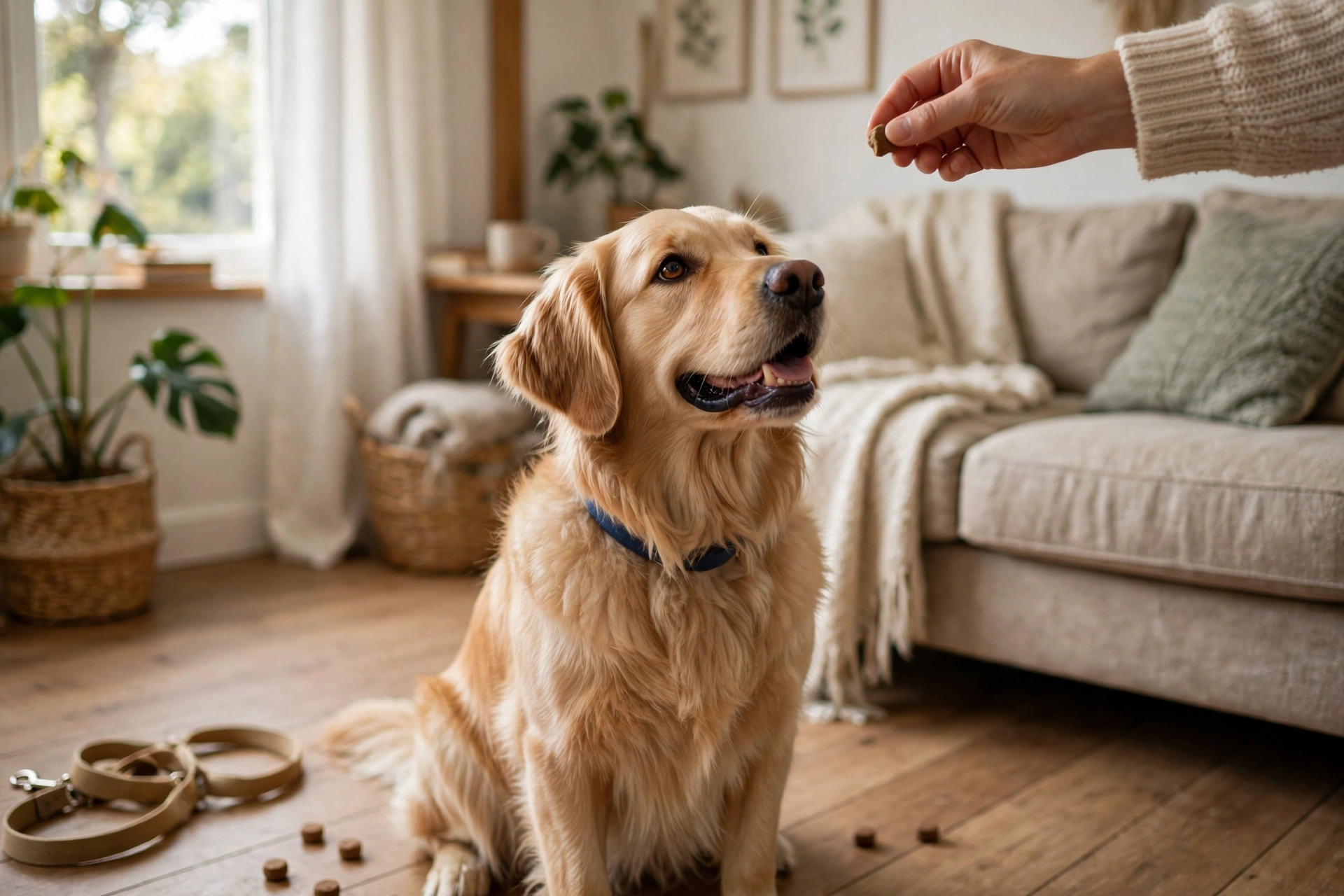
A dog that comes when called, sits while you open the door, and walks beside you instead of dragging you down the street did not learn those things by accident. Somebody taught them, a little at a time. The good news is that somebody can be you. Learning how to train a dog at home needs no special talent — just a clear plan, a calm voice, and patience. Among the many pet care tips you will find online, the honest ones agree on one thing: dogs learn best from the people they live with, in the place they live.
This guide covers how dogs learn, what you need, the first six cues, house training, crate training, loose-lead walking, everyday problems, and a simple four-week plan. Whatever your dog’s age, the method is the same: start small, reward what you like, and keep going.
Quick Facts
- Best age to start: Puppies can start from about eight weeks old; adult dogs can start at any age
- Session length: Five to ten minutes, two or three times a day
- Method: Reward-based training, recommended by veterinary behaviour specialists
- First cues to teach: Name, sit, down, stay, come, leave it
- Reward timing: Within one or two seconds of the behaviour you want
- What you need: Small tasty treats, a treat pouch, a lead, a quiet room
- House training: Take the dog out in the morning, after meals, after play, and before bed
- Realistic timeline: Most dogs understand the basic cues within two to three weeks
- What to avoid: Shouting, hitting, choke chains, prong collars, and shock collars
How Dogs Actually Learn
Dogs learn by association. When a behaviour is followed by something good — a treat, a game, a kind word — the dog becomes more likely to repeat it. When it earns nothing, the dog becomes less likely to do it again. Every technique in this guide is built on that.
Timing is everything. A reward given two seconds after a sit lands on the sit; one given ten seconds later lands on whatever the dog was doing at that moment. That is why trainers use a marker word — a short, sharp “yes” — or a clicker.
The American Veterinary Society of Animal Behavior recommends reward-based methods and warns that shock collars, prong collars, and harsh corrections risk fear, stress, and aggression. Punishment can look effective while quietly making things worse.
Consistency is the other half of the job: everyone in the house needs the same words and rules. If one person rewards jumping up and another pushes the dog away, it stops listening to either.
What You Need Before You Start
You do not need much. First, treats: small, soft, smelly ones your dog loves — tiny pieces of cooked chicken, cheese, or soft training treats — kept in a pouch so you can deliver one within a second or two. Second, a marker: one short word, such as “yes,” said in a bright voice the instant your dog does the right thing, followed by the treat. Third, a lead and a comfortable collar or harness; avoid retractable leads, which teach a dog that pulling makes the lead longer.
Fourth, a quiet room: start where distractions are low, such as a living room with the television off. Once a cue works there, practise it in the garden, then on a quiet street, then in busier places. Train in two or three short sessions of five to ten minutes a day, ideally before a meal when your dog is keen. End every session on a success, and finish with a game so the dog remembers training as something good.
The First Six Cues Every Dog Should Know
Teach one cue at a time, and do not move on until it works most of the time. Each cue builds on the one before it.
1. Teach your dog its name
Say your dog’s name once, in a cheerful voice. The moment it turns toward you, say “yes” and give a treat. Repeat a handful of times, then stop. Do not repeat the name if the dog ignores you — saying it five times teaches it to ignore the first four.
2. Teach “sit”
Hold a treat close to your dog’s nose, then slowly move your hand up and back over its head. As the dog follows it, its bottom will usually lower to the floor. The instant it sits, say “yes” and give the treat. Repeat five to ten times. Once the dog follows the lure smoothly, say “sit” just before you move your hand.
3. Teach “down”
With your dog sitting, hold a treat at its nose and slowly lower your hand to the floor, then slide it away from the dog. Most dogs will follow it down into a lying position. Mark and reward the moment the elbows touch the floor. If the dog stands up, try again more slowly.
4. Teach “stay”
Start with the dog sitting. Hold your open palm toward it like a stop sign and say “stay” in a calm voice. Wait one second, then say “yes” and give the treat while the dog is still in position. Use a release word such as “okay” to end the exercise. Build up slowly, adding one second at a time, then one step back. Only ever increase one thing at a time — distance, duration, or distraction.
5. Teach “come”
A reliable recall is the most important safety skill your dog will ever learn. Start indoors, a few steps away. Crouch down and say your dog’s name followed by “come” in a happy voice. When the dog arrives, reward generously. Never call your dog for something it dislikes, such as a bath, or it will learn that “come” means the fun is over. Practise in the garden on a long line before trying it anywhere open.
6. Teach “leave it”
Hold a treat in your closed fist and let the dog sniff it. Say “leave it” once, and wait. The moment the dog pulls its nose away, say “yes” and give a better treat from your other hand. Never give the dog the treat it was told to leave. Once the dog understands, try it with a treat on the floor under your hand, then uncovered.
House Training
House training is mostly management. Take the dog outside first thing in the morning, after every meal, after play, after a nap, and last thing at night. Puppies may need to go out every hour or two.
Choose one spot in the garden and take the dog there on the lead. When it goes, praise calmly and give a treat. Watch for the signs: circling, sniffing the floor, heading for the door, or suddenly stopping play.
Accidents will happen. Clean them up without a fuss. Never rub a dog’s nose in a mess or punish it after the event — a dog cannot connect a punishment now with something it did ten minutes ago. Ask what went wrong instead, and fix the routine, not the dog.
Crate Training
A crate is not a cage and it is not a punishment. Used properly, it is a den — a safe place where a dog can rest, sleep, and be left alone without getting into trouble.
Make the crate inviting: a soft bed, a chew toy, a worn T-shirt that smells of you. Leave the door open and let the dog explore it. Feed meals just inside the door at first, then further back. Once the dog walks in happily, close the door for a few seconds, then open it and praise.
The crate should be big enough for the dog to stand, turn around, and lie down stretched out, but not so big that it can sleep in one end and toilet in the other. Never leave a puppy in a crate for longer than it can hold its bladder — roughly one hour per month of age.
Loose-Lead Walking
Walking nicely on a lead is the skill owners struggle with most. Start in the garden or a quiet street. The moment the lead goes slack, say “yes” and give a treat. The moment it goes tight, stop walking and stand still. When the dog turns back and the lead slackens, praise and walk on.
This takes patience, and your first walks may cover very little ground, but the lesson is clear: pulling gets you nowhere, and a loose lead gets you moving. Practise short stretches of five to ten steps, rewarding the dog for staying beside you.
Everyday Problems and How to Fix Them
Most “bad behaviour” is normal dog behaviour in the wrong place. Training does not stop it; it gives the dog a better thing to do instead.
Jumping up. Dogs jump up because it works: a jumping dog gets attention. Make jumping earn nothing and sitting earn everything. When the dog jumps, turn away calmly. The moment all four paws touch the floor, ask for a sit and reward it.
Barking. Barking is how dogs talk, so the aim is not silence — it is control. First work out why the dog barks: the doorbell usually means excitement or alarm, while barking when left alone is often distress, which needs shorter absences and a settled routine. Teach the dog to go to its bed when the bell rings.
Chewing and digging. Puppies chew because their teeth hurt; adult dogs chew because they are bored, anxious, or full of energy. Give the dog legal things to chew — sturdy chew toys, stuffed food toys, a frozen carrot — and keep shoes and cables out of reach. If you catch the dog chewing something it should not, swap it calmly for a toy. Digging is often the same story: a bored dog with nothing to do.
Pulling on the lead. The rule never changes: a tight lead means the walk stops, and a loose lead means it starts again. Keep walking while the dog pulls and every step forward rewards the pulling.
How to Train a Dog at Home: A Simple Four-Week Plan
A plan keeps you honest.
Week 1 — Settle in. Teach the dog its name and sit. Start house training and the toilet routine. Get the crate comfortable. Run two or three five-minute sessions a day.
Week 2 — Add down and stay. Practise name and sit in different rooms. Introduce down, then a short stay of one or two seconds. Start loose-lead walking in the garden.
Week 3 — Add come and leave it. Practise all six cues in the garden and indoors. Start taking the dog to quiet streets. Introduce the bed or mat as a settling place.
Week 4 — Add distractions. Practise with mild distractions: a family member walking past, a toy on the floor, the television on. Try a short walk on a quiet street, asking for sits at kerbs and before crossing.
Mistakes That Slow Training Down
- Sessions that are too long. A bored dog stops learning. Five focused minutes beat twenty distracted ones.
- Repeating the cue. Saying “sit, sit, SIT” teaches the dog to wait for the third shout. Say it once.
- Inconsistent rules. A dog allowed on the sofa on weekdays and scolded for it at weekends cannot learn the rule.
- Punishing after the event. A dog found next to a chewed shoe an hour later has no idea what you are upset about.
- Moving too fast. Adding distance, duration, and distraction all at once is a recipe for failure.
When to Get Professional Help
Most dogs can be trained at home, but some problems need a professional. If your dog growls, snaps, or bites, do not try to train through it alone — that is a safety issue. The same applies to severe fear, separation distress that does not improve, or behaviour getting worse despite your best efforts.
Look for a trainer who uses reward-based methods and is happy to explain what they do and why. Ask what qualifications they hold. Avoid anyone who promises a quick fix, guarantees results, or uses shock collars or prong collars. A good trainer teaches you to train your dog. Your vet can often recommend someone local.
A short note on safety: this article is general information, not a substitute for professional advice about your individual dog. If your dog is unwell, in pain, or behaving strangely, speak to your vet first — pain and illness change behaviour.
Frequently Asked Questions
How long does it take to train a dog at home?
Most dogs understand the basic cues — sit, down, stay, come, leave it — within two to three weeks of short daily sessions. Reliable behaviour around distractions takes longer, usually a few months of steady practice. Age, breed, and temperament all play a part, and rescue dogs with no previous training may take a little longer to settle before they start learning quickly.
What age should you start training a dog?
You can start simple training with a puppy from about eight weeks old, keeping sessions to two or three minutes. Adult dogs can start at any age, and older dogs are often calmer and quicker to focus than puppies. It is never too late to teach an old dog new cues, though a habit that has been practised for years will take longer to change than a new one.
How many minutes a day should I train my dog?
Two or three sessions of five to ten minutes a day are enough for most dogs, and more effective than one long session. Puppies do best with two or three minutes at a time. Fit training around meals, using part of the dog’s daily food as training treats, so the practice becomes part of the routine rather than an extra job.
Can I train my dog without treats?
Treats are the clearest way to reward a dog, especially at the start, but they are not the only reward. Play, a favourite toy, praise, and the chance to go outside are all rewards, and many dogs will work for them. The trick is to find what your individual dog values most and use it at the right moment. Most trainers start with food because it is fast and reliable, then gradually mix in other rewards.
Why does my dog listen at home but not outside?
Because outside is harder. Every new place, smell, person, and dog is a distraction, and a cue the dog knows in a quiet room is a new challenge in a busy park. This is normal. Build up gradually: practise in the garden, then on a quiet street, then in busier places, rewarding generously at each new step. If the dog cannot respond, you have moved too fast — go back a stage and make it easier.
Is it okay to train a dog with a clicker?
Yes. A clicker is a small device that makes a sharp sound, used to mark the exact moment a dog does the right thing. It works exactly like a marker word such as “yes,” but the sound is more precise and always the same. To use one, click and give a treat about ten times so the dog learns that the click predicts food, then use it to mark behaviours as you train. A clicker is a tool, not a magic device, and a clear marker word works just as well.
Should I send my dog to a board-and-train programme?
It depends on the dog and the programme. A good programme can help, but the dog still needs to practise with you at home afterwards, because dogs behave differently with different people. Before choosing one, ask what methods they use, whether you can watch a session, and what follow-up support they offer. Avoid any programme that uses punishment-based methods or will not tell you how it trains.
Conclusion
How to Train a Dog at Home is not a test of talent. It is a test of patience and consistency, and those are things any owner can learn. Start with the basics — a name, a sit, a short session, a pocket of treats — and build from there, one cue at a time.
The payoff is a dog that comes when called, waits at the door, walks calmly, and settles when you ask. That is worth a few minutes a day. For readers who want to check the background facts about dogs and training, a general reference is a good place to start.
